The Trillion Dollar Failure
Musings by Thinking Studios’ founder.
The paradox.
Here’s something you might not expect someone to say in 2026 — making money off of AI couldn’t be more difficult. Well, at least if you’re a company that is.
I know, I can hear the, “but, but, buts,” coming — take a breath, a deep one, and hang on. I’ll explain everything.
We all have heard the same stories over and over again from news outlets of all kinds, audiences, and political leanings. It seems like every day there’s a story about:
Another multi-million dollar raise…by a derivative AI startup solving no ones’ problems.
Another round of financing for an agentic framework…that fails more times than it succeeds.
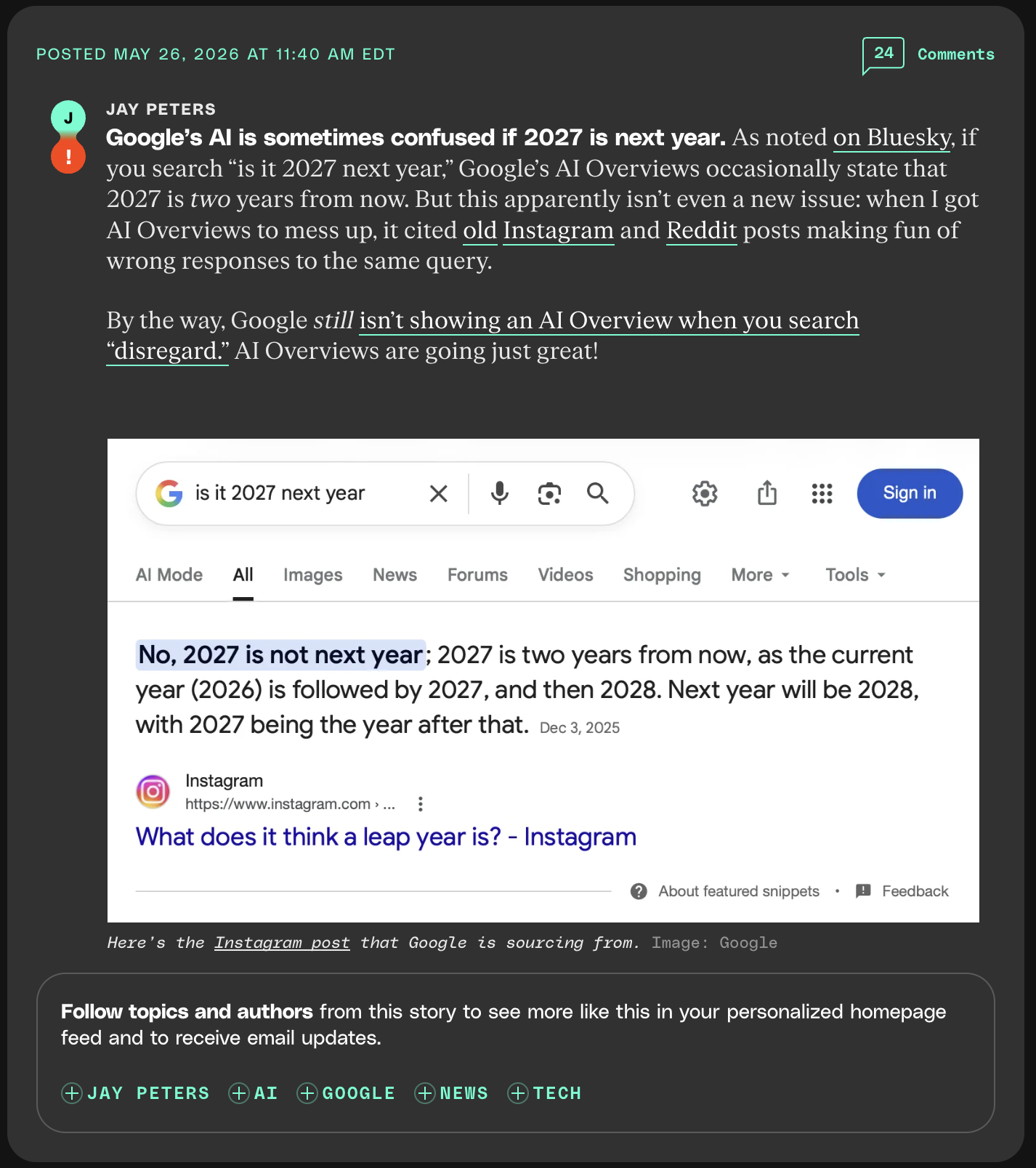
Another IPO for the “frontier” model builders whose work — made with hundreds of billions of dollars of other people’s money — still struggles with getting the date right.¹
How did we get here?
When ChatGPT first hit the scene on November 30, 2022, new players like OpenAI and Anthropic rose to immediate prominence and began to promise a different version of the future. A future where human work and capability isn’t replaced, but instead augmented and enhanced, by AI. Where prosperity is achieved for not just the 1% as has always been the case but for the ordinary person who is struggling to make ends meet. AI, it has been promised, will close that gap for good.
We can judge these actors on their word — here are some quotes from pre-eminent maker of "digital god"², Sam Altman:
“AI will be the greatest technology humanity has ever developed to help us solve the world’s hardest problems.” — Testimony to Congress³
“People have an innate desire to create and to be useful to each other, and AI will allow us to amplify our own abilities like never before.” — The Intelligence Age⁴
“AI will be the most powerful tool for expanding human capability and potential that anyone has ever seen. Demand for this tool will be essentially uncapped, and people will do incredible things with it. The world deserves huge amounts of AI and we must figure out how to make it happen." — From his personal blog⁵
Now, if you’re thinking, “This all sounds great…but what’s the catch?” Well, here are some more quotes by pre-eminent snake oil salesman, Sam Altman:
“People have a valid reason to feel anxious about AI, particularly when considering its potential to outperform professionals in numerous occupations.” — CNBC⁶
“It will not all go well. The fear and anxiety about AI is justified; we are in the process of witnessing the largest change to society in a long time, and perhaps ever.” — From his personal blog⁷
"I think AI will probably lead to the end of the world, but in the meantime, there’ll be great companies created."⁸
Yikes.
What decidedly isn’t mentioned? Revenue, profit, and most importantly, customer satisfaction — you know, the building blocks of a sustainable business.
OpenAI et al. promised a future without even being able to pay for the present. And the reason is simple — their products simply do not work.
“It’s not supposed to work, it’s supposed to make me rich.”
The AI industrial complex runs on a simple axiom:
It does not matter if the thing works, as long as it makes the people involved rich.
Let’s look at the facts critically.
On the one hand, does AI work?:
Roughly 95% of enterprise AI pilots fail to deliver what they promised.⁹
AI is financially superior to a human worker on only 25% of the white-collar tasks it is being bought to replace.¹⁰
90% of firms reported no measurable impact of AI on productivity at all.¹¹
Google AI Search Overviews still don’t even know that next year is 2027.¹
And then on the other, what does repeated public failure buy someone?:
A Koenigsegg Regera for, checks notes, nonprofit CEO Sam Altman¹²
A superyacht valued more than the island it’s docked at for alpha-male, Mark Zuckerberg¹³
A $1T pay package justified by running a company that literally makes autonomous death machines like Elon Musk¹⁴ ¹⁵
How can 19 more billionaires be minted in the same year that 71–73% of workers expect AI to take jobs?¹⁶
And these are just the builders. Industry leaders are no better — replacing their workforces with flawed AI replacements to see company share values skyrocket.
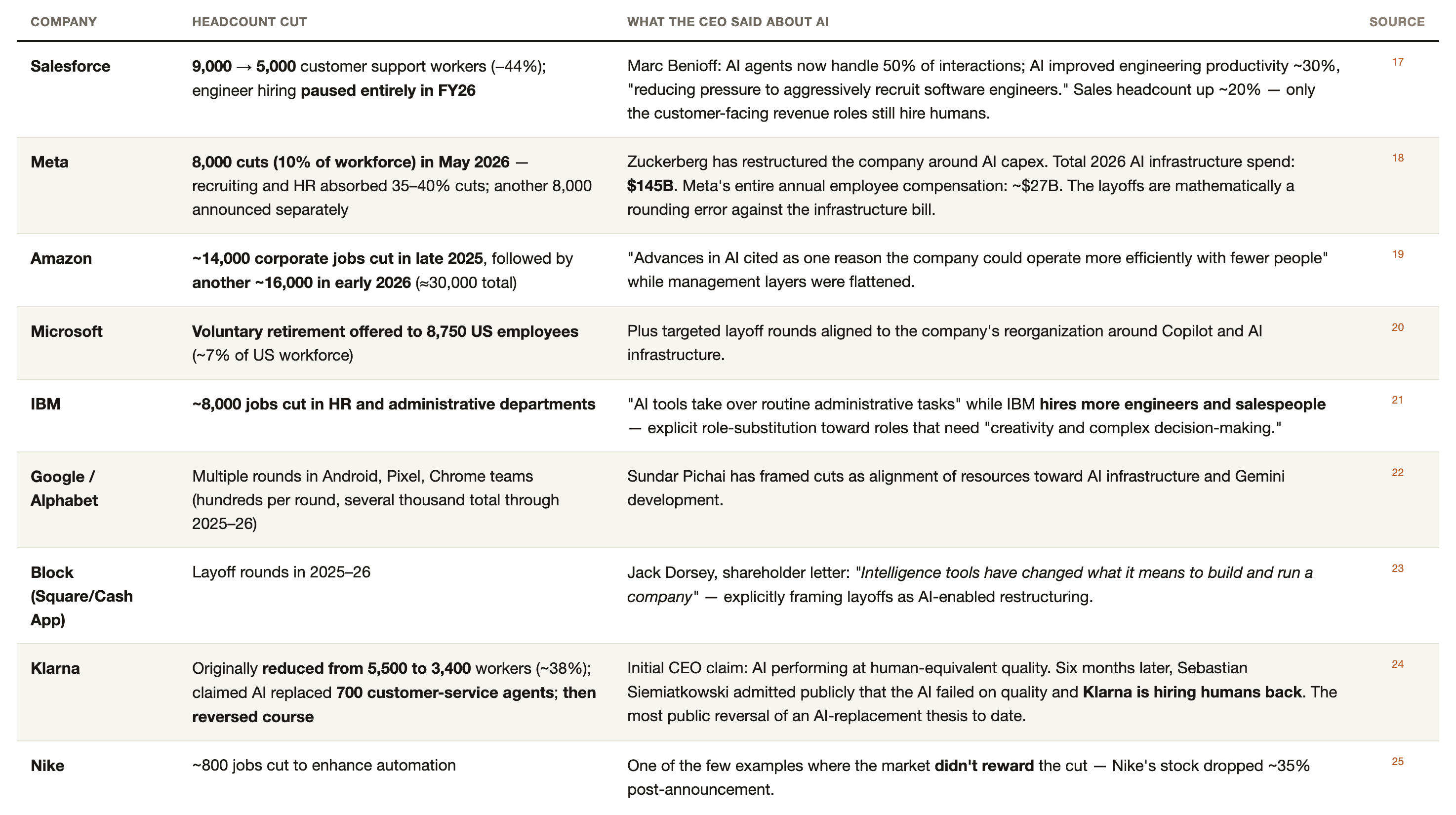
No surprises here either: it’s not the employees being laid off who own those shares.
“A million dollars isn’t cool. You know what’s cool?”
So where is this money really going?
Trick question actually — it doesn’t go anywhere due to a sneaky concept called circular financing.
Circular financing is when several companies use natural synergies to pass the same capital around to one another in a closed loop. Nvidia invests in OpenAI; OpenAI commits that investment to cloud providers; the cloud providers then spend that revenue on Nvidia chips. At each pass, the money is counted as revenue — it looks organic, feels organic, but is in fact just a house of cards.²⁶
Now if you’re a millennial like me, this all might sound a bit too familiar. For those too young to remember, I’ll give a quick refresher.
Way back in the mid-aughts, finance and investment professionals got a bit too smart for their own good (and everyone else’s but we’ll get to that). Mortgages — something that are supposed to be the bedrock of the American economy and more broadly the American Dream — started to get riskier. Lenders started issuing mortgages to everyone. And while this is laudable in principle, it was the furthest thing from altruism. For example, NINJA loans that took advantage of black and brown folks, particularly immigrants with English as their second language, became popular. Emigrant Bank ran a program called STAR NINA that marketed these no-documentation loans specifically to Black and Latino homeowners in New York City, then slapped anyone who missed a single payment with an automatic 18% default interest rate. Countrywide did the same thing at national scale — steering more than 200,000 Black and Hispanic borrowers into subprime loans, a practice it eventually settled with the Department of Justice for $335 million.²⁷
All the while, these sub-prime mortgages ended up in people’s retirement accounts — about the only place regular, everyday people actually have money in the stock market. And when the curtain came down on the biggest financial crisis since the Great Depression, it was those same regular, everyday people that had to pick up the check via a government bailout. How many people went to jail over what was, at the time, an unprecedented degree of fraud? One. His name was Kareem Serageldin, a mid-level Credit Suisse trader who got 30 months for mismarking bonds — while the executives who ran the institutions into the ground walked.²⁸
“Well, surely we’ve learned from THAT ordeal, right? There’s no way even this regime would let that happen? They have to be accountable to something or someone…right?” Well…
The two worst IPOs in history
Now there’s junk and then there’s junk and…I’ll just give you the facts about these two IPOs, SpaceX and OpenAI. Let’s start with OpenAI because it’s the “rosier” picture. (I guess when you’re competing against something that called itself “MechaHitler” as a compliment, you win by default.)
OpenAI — A nonprofit, sort of.
“We don’t ever want to be making decisions to benefit shareholders. The only people we want to be accountable to is humanity as a whole.” — Sam Altman²⁹
That went out the window pretty quick, didn’t it?
Now, Sam Altman appears to have always had a problem with the truth.¹² But there are three things that can’t be lied about.
OpenAI’s financials are, charitably, not great.³⁰
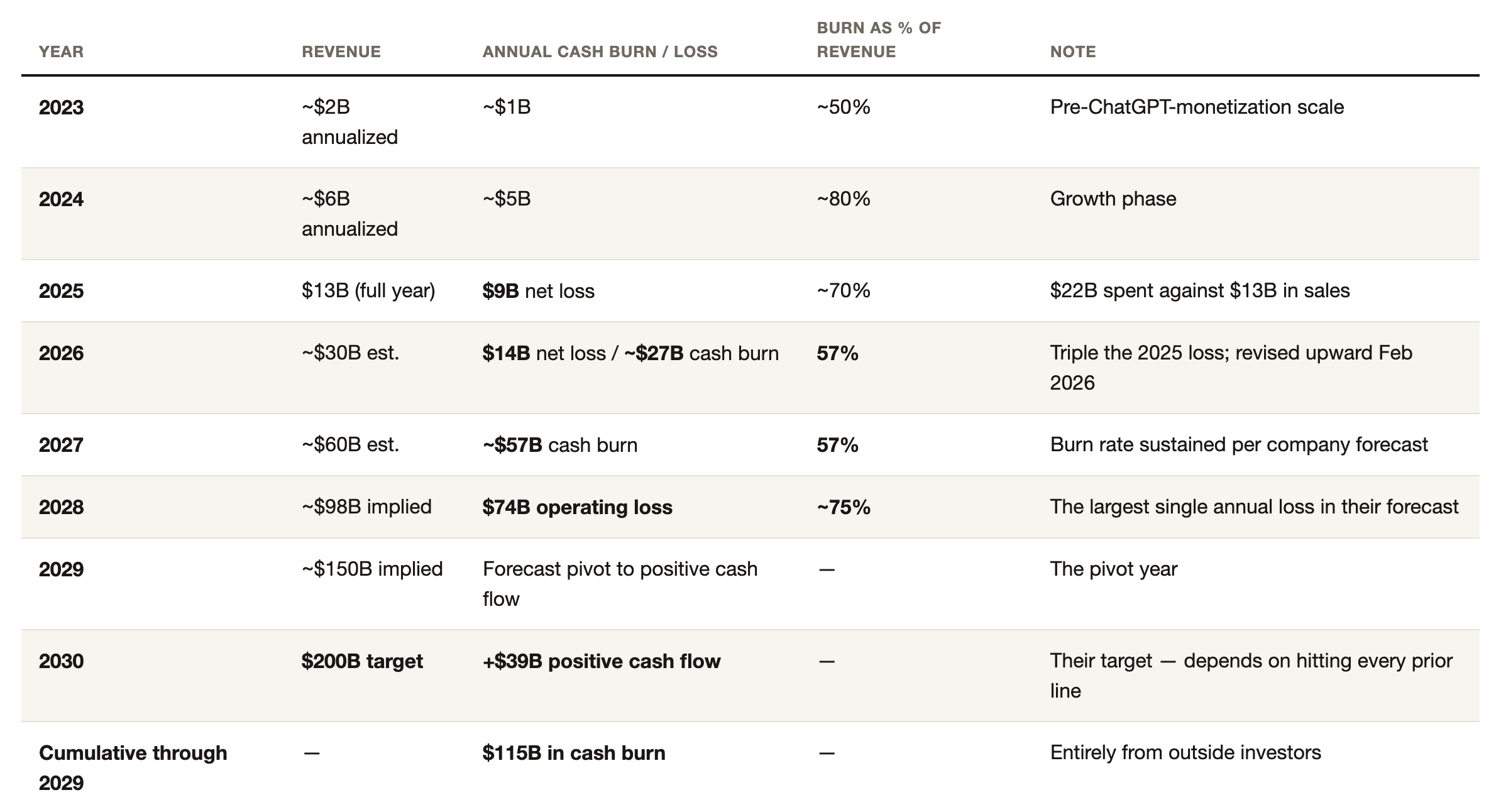
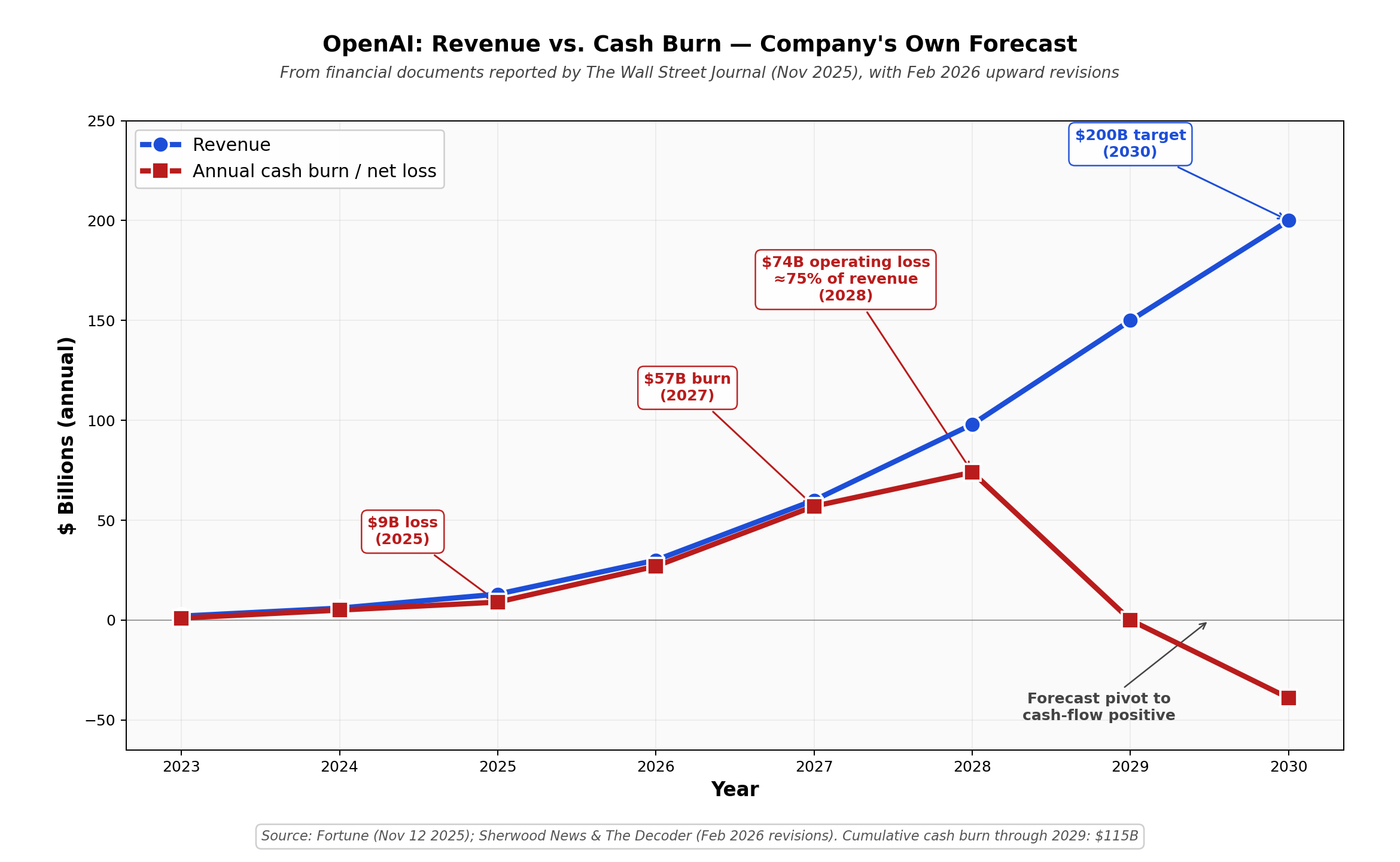
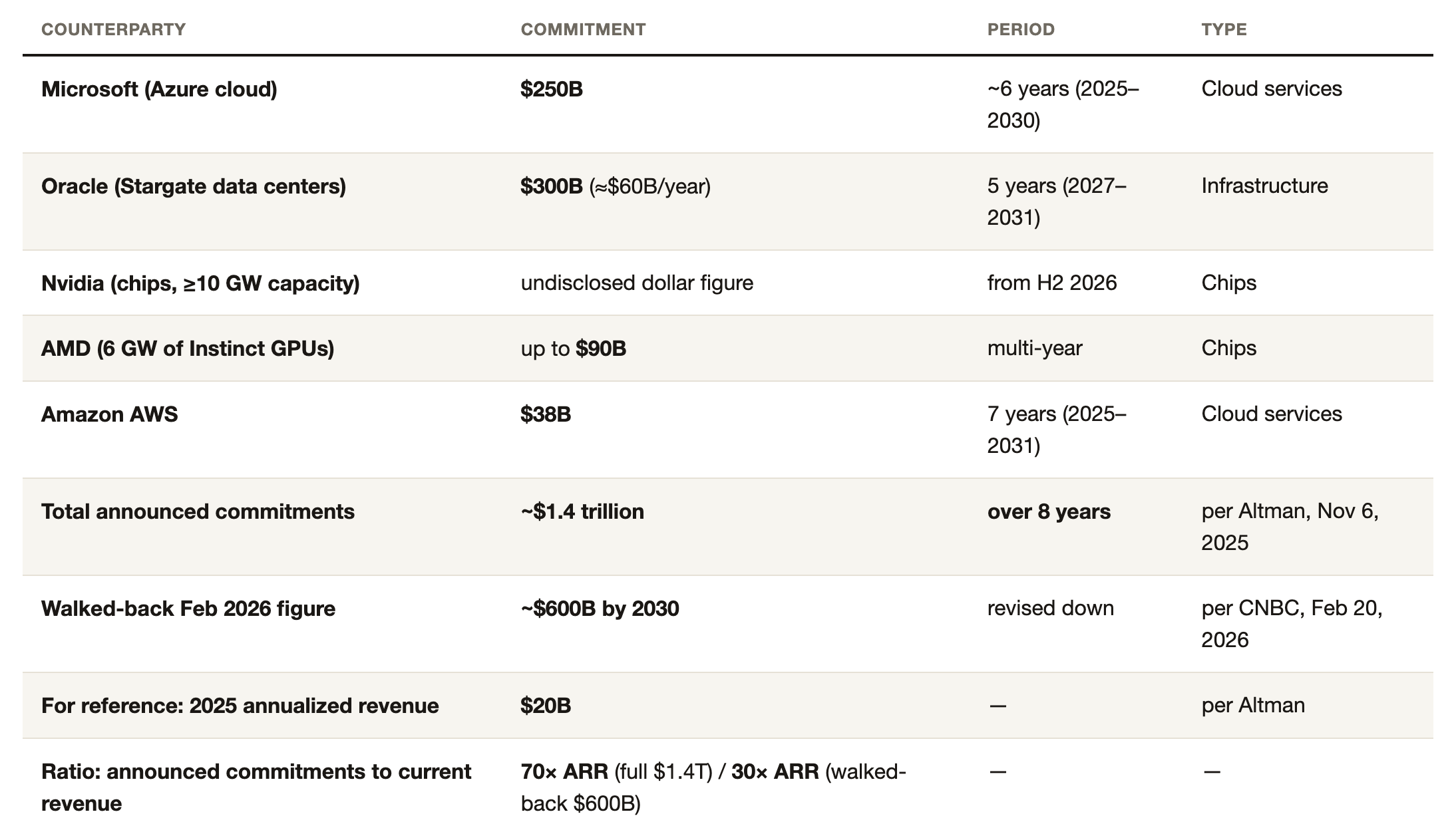
OpenAI makes $20B in ARR…with $1.4T in commitments.³¹
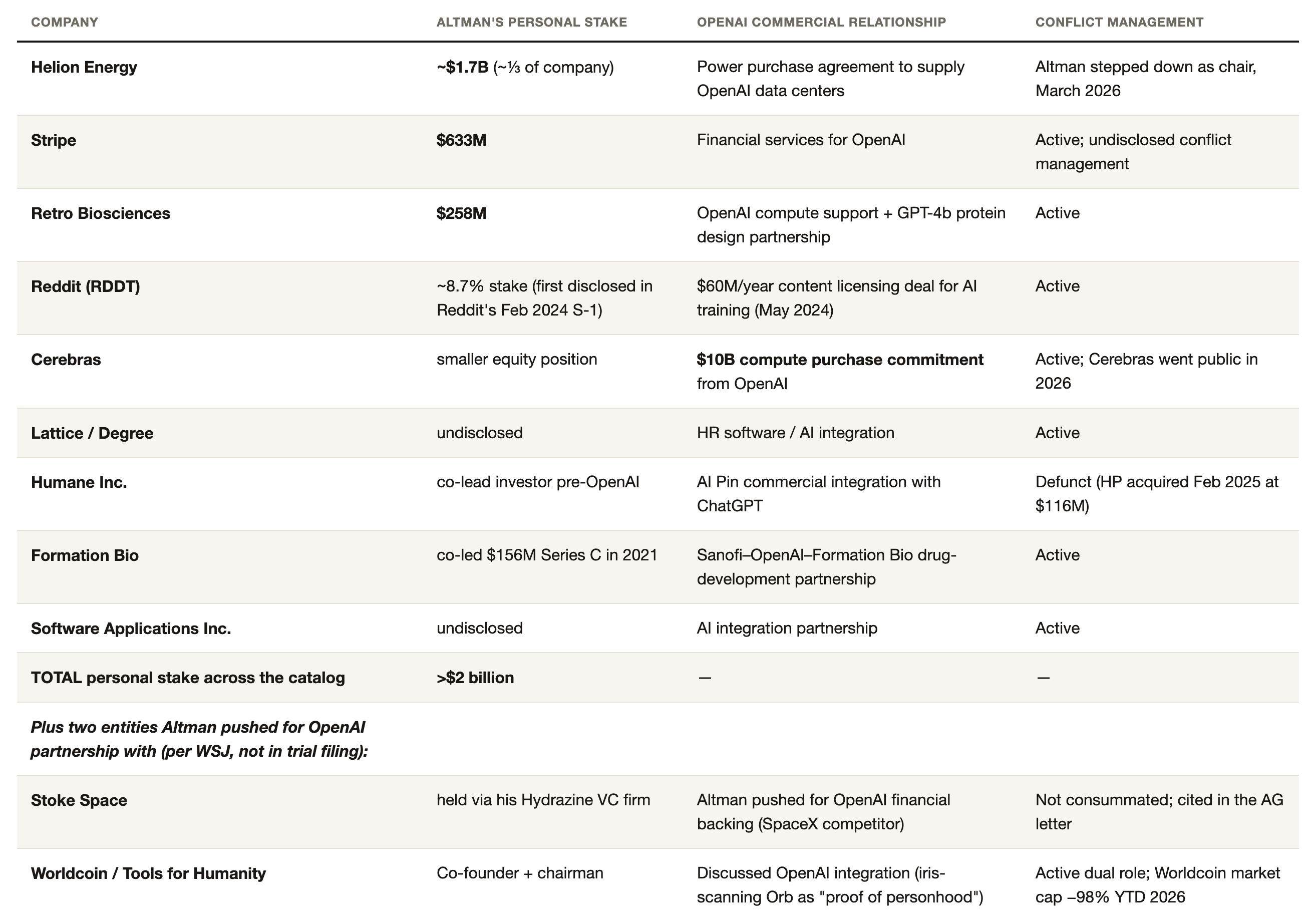
Sam Altman sure does have a lot of ownership stake in companies OpenAI has a relationships with.³²
And from the Montana Attorney General, Austin Knudsen:
“The SEC should review any filings submitted by OpenAI to ensure Montana’s investment funds and public pensions are protected before moving forward with an IPO.”
"It is essential that investors receive clear notice of any conflicts of interest on the part of Altman or other senior OpenAI personnel."³³
And that’s without even touching on the circular financing from earlier! (Ancestors…)
Somehow, despite all that and the general untrustworthiness of their CEO, they’re second worst to…
SpaceX and the world’s first trillionaire
…Elon Musk and SpaceX.
I mean, what more has to be said about him and his companies? MechaHitler³⁴, child porn factory³⁵, “spicy” avatars³⁶ — these are all somehow small, superficial issues compared to some of the deeper, more insidious ones:
Twitter is even more of a racist, fascist cesspool than ever before.
xAI is burning through $1B a month and its models are so risky to use that even the Trump administration is refusing.³⁷
SpaceX doesn’t actually know how to do their primary job — build rockets and launch them into space.³⁸
And yet, here we are with June 12, 2026 — the day SpaceX gets listed on the Nasdaq — being a digital D-Day if there ever was one.
I mean, just look at this shit:
“If you compare xAI to a traditional SaaS company, the financials look reckless." — Senior research analyst, PitchBook, via Morningstar (May 2026)³⁹
xAI poses a “material threat of value destruction” and its competitive position against OpenAI and Anthropic leaves its “economic moat indeterminate.” — Morningstar analyst assessment, June 2026 (calling the $1.75T valuation “nearly twice fair value”)⁴⁰
“SpaceX’s float will mostly be gobbled up by passive funds, which sets the perfect trap to transfer wealth from retail investors to company insiders.” — Sean Williams, The Motley Fool, June 6, 2026 (headline of same piece: “Prediction: The SpaceX IPO Will Be the Greatest Fleecing of Retail Investors We’ve Ever Witnessed”)⁴¹
SpaceX financials
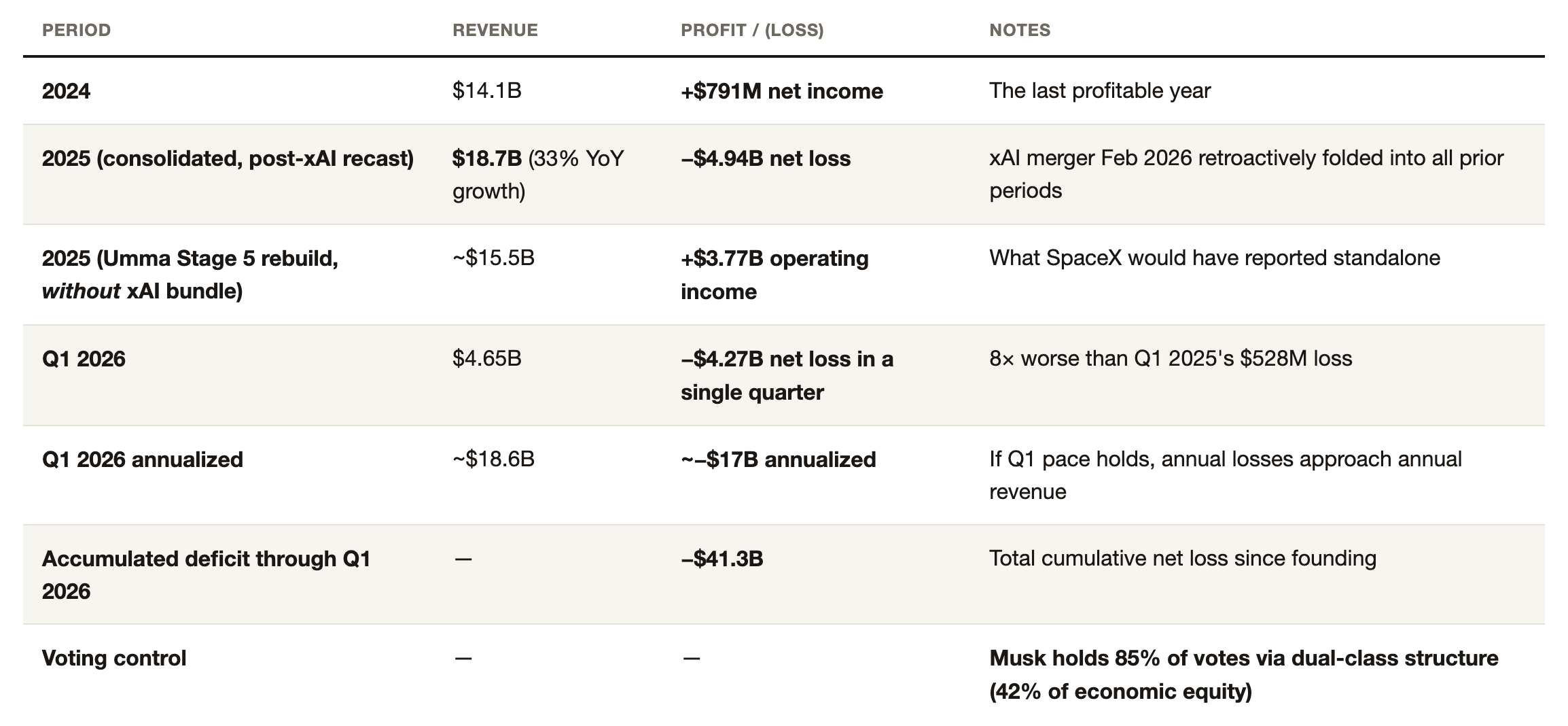
Source: see footnote.⁴²
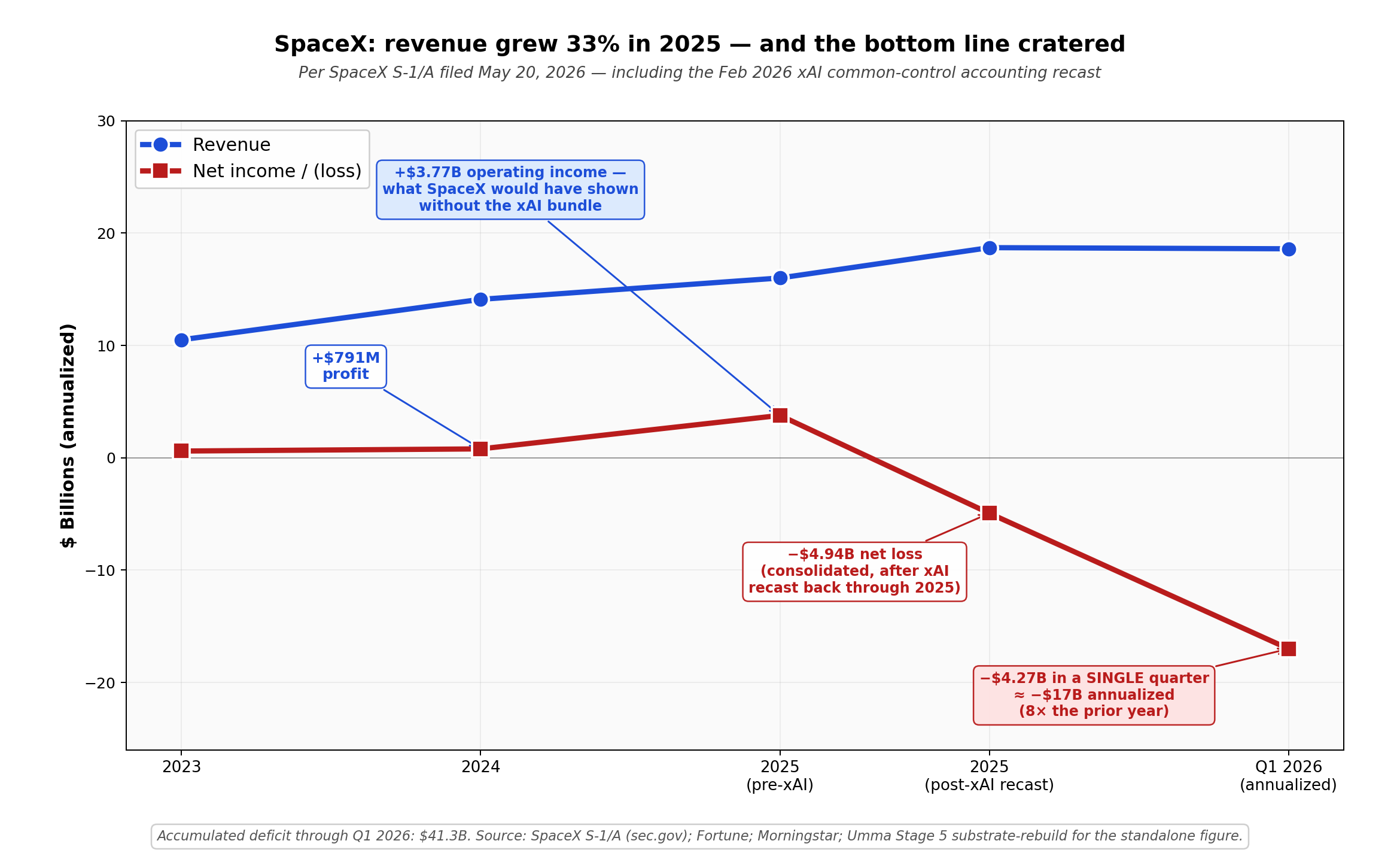
SpaceX valuation
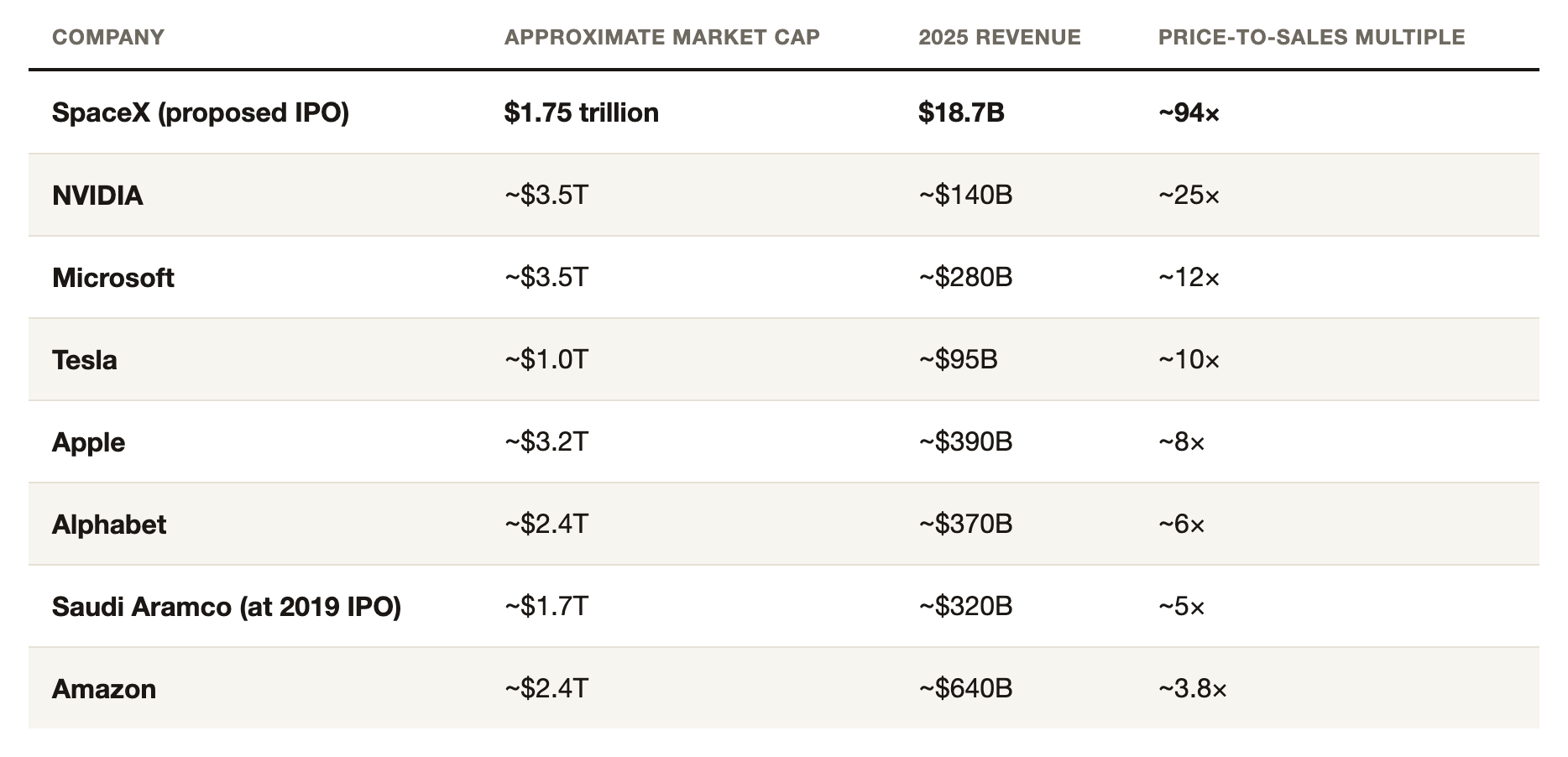
To match peer multiples at SpaceX’s current revenue, the company would need to be valued at roughly $150–225B — one-tenth of its proposed listing target. Equivalently: to justify $1.75T at a “normal” tech P/S of 8×, SpaceX would need $219B in annual revenue. It has $18.7B. BitMEX calls 94× “a multiple that has no precedent among the world’s most valuable companies.”⁴³
Nilay Patel of The Verge made a really good point recently — yes, Twitter has completely fallen apart under Musk’s ownership…but that might have been the point. To paraphrase him, Musk really just needed a megaphone to spout whatever came to his mind — particularly “thoughts” related to his own companies’ “great” performance. All in the pursuit of wealth concentrated at a level that the world has never seen.⁴⁴
The doomsday scenario
So how bad is it?
Bad. Very bad. Worse than what’s being reported.
I’ve run my own analysis on both the SpaceX and OpenAI IPOs using an operating system I’ve developed named Umma, named for the Korean word for “mother”.
She does several things that stand in stark contrast to the industry — Umma is honest about her capabilities, doesn’t hallucinate by grounding everything in traceable sources both external and internal to herself, and never forgets or lies. All brought together by an architecture and design inspired by cognitive science and research specifically in metacognition (i.e., the mind’s ability to “think about thinking”). I’ll go into more detail on her in the coming days but for now, let’s just say that she can do things other models and frameworks cannot — and I have the receipts.
She was able to determine who gets hurt when this all falls apart, when, how, and why.
(Without getting too in the weeds on her methodology, she coded and ran a 3-state regime-switching Markov model, the same family of models the Fed actually uses to stress test the banking system…on live Fed data she collected… autonomously from a single prompt in about three hours…I’m out of breath already. Let’s move on.)
Here are her findings:
Who gets hurt the worst
4 to 7 million Americans aged 55 to 65 with $200,000 to $500,000 saved for retirement in default retirement funds that their employers auto-enrolled them in.
If the crash hits as they’re starting to retire, they lose 25 to 40 percent of their retirement income permanently — for the rest of their lives.
When, and how bad
Roughly coin-flip odds (35–61%) that the first domino falls within the next three years.
3 to 10 percent chance the full chain reaction plays out and if it does: $15 to $25 trillion in savings wiped out — one-and-a-half to two times worse than 2008. The broad stock market drops about 42%; default retirement funds drop 42–48%.
How the damage actually happens
It happens automatically as the default retirement funds are programmed to sell on a schedule when the market drops. We don’t have to make a single bad decision for this to affect us.
Why this time is different from every prior crash
1929 and 2000: ordinary people panicked. 2008: banks froze. This time: the automatic plumbing of retirement funds is the engine.
BlackRock — the largest manager of these default retirement funds — increased its bet on the four stocks that make up a quarter of the entire S&P 500 (Nvidia, Microsoft, Amazon, Google) as recently as June 2026 instead of de-risking.
By the time the damage shows up in your 401(k) statement, the people who saw it coming are already out
There’s a lot more here to dig into — how this was put together by Umma, what she did and how — but that will come later this week. For now, all I can say is what Samuel L. Jackson said in “Jurassic Park” — hold onto your butts. (And your 401k’s.)
Are we all just f’ed?
I wish I knew for sure and I’m of two minds about it —
On the one hand, the writing on the wall is pretty bleak.
The University of Michigan Consumer Sentiment Index fell to 47.6 in April 2026 — the lowest reading in the survey’s 74-year history. American consumers are now more pessimistic about the economy than at any time on record.⁴⁵
“More people in the United States are going hungry now than during the depths of the COVID-19 pandemic.” — NPR / New York Fed reporting, summarizing USDA and Federal Reserve data showing 13.7% household food insecurity in 2024.⁴⁶
“The top 1% of households controlled 31.7% of the nation’s wealth in Q3 2025 — $55 trillion. The bottom 50% held 2.5%. The share of total wealth held by the richest Americans is now at the highest level since World War II.” — Bloomberg, summarizing Federal Reserve Distributional Financial Accounts data.⁴⁷
“In 2026, about 76% of U.S. households are living paycheck to paycheck.” — U.S. Rep. Joyce Beatty, citing PYMNTS/CivicScience tracking data.⁴⁸
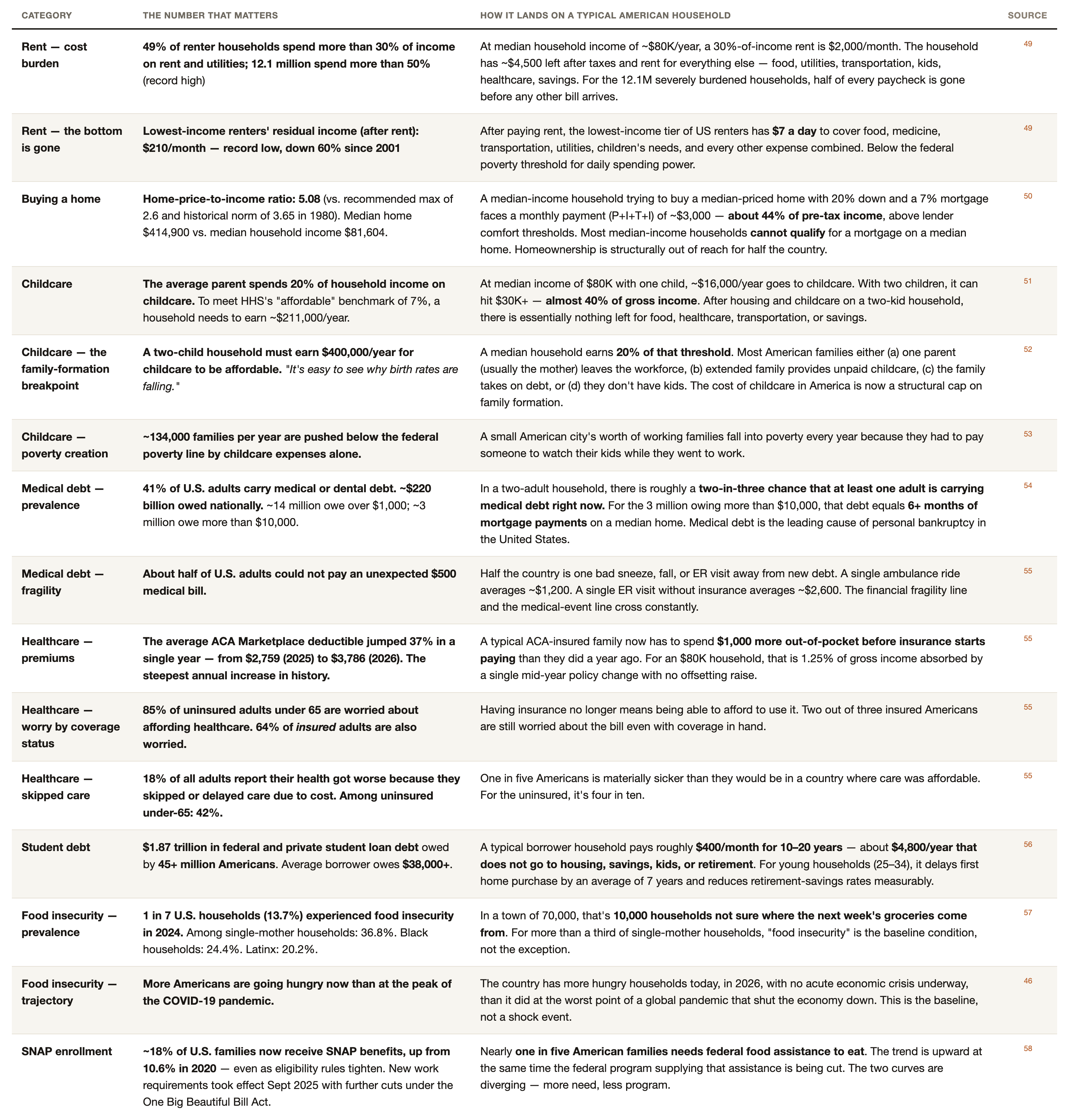
None of that breeds much confidence. Particularly as America continues its own political decline away from democracy and into fascism. But…
On the other, there is hope:
I may sound all doom and gloom but I would be remiss if I didn’t point out two things that have given me a profound sense of hope recently:
I’ve never been a big “60 Minutes” guy but the way Scott Pelley has handled Black Thursday and his subsequent dismissal has been inspiring.⁶⁰ To hear him talk about how, because he was the only senior person in the room, he felt an obligation to do what was right is an example of selflessness and integrity that’s been missing from the media up and down the board.
And the Democrats could gain control of the entirety of Congress come November. (I’m really knocking on wood here and hoping this is a reverse jinx. Do I trust them to pull this off? I’ll leave it to Drew Magary to cook.)
And this all in the face of Our Dear Leader, Trump, showing up at Madison Square Garden later tonight for the Knicks’ first home finals game in 27 years. Since moving out of the city three years ago, I’ve never liked going back…but I’d make an exception to hear that crowd give it to him.
People are mad as hell and they may actually not be willing to take it anymore.
All that sounded good…but what’s in this for you?
Now that’s a great question.
I’ve already admitted that I’ve built something in the AI space — this is true and undeniable. And yes, I do believe that Umma is more capable than anything else out there. But I raise it not to try and stump for myself; I raise it as proof that something better can exist if we just Think Differently.
Why do we have to capitulate to the idea of hallucinations — so much so that the idea of “truth” itself has been diminished in America’s culture, society, and values?
Why do we have to assume that forgetfulness is a feature and not a bug — and that there is no accountability because of it?
And why do we feel the need to be flattered when the hard truth and radically accepting it are the only things that can truly set us free?
I started building Umma and founded a company to provide for my family — my partner, Andy Marra, and our three pugs. And I wrote this essay to raise awareness on what the AI industry is doing to hurt everyday people and families like us in the hope that we can all do something about it.
I am a Korean adoptee who almost certainly was adopted under corrupt and false pretenses.⁵⁹ I grew up in a small town in Southern New Jersey where I experienced racism on a daily basis from my family, friends, and environment. College was no better (going to school in Gettysburg, PA will do that), and neither was working in both white-collar and blue-collar professions. (Started as a concert pianist in high school, then behavioral economics and finance, then Michelin-starred cooking, before injuring my hips and transitioning to…data science. Now that’s a BINGO card.) I’ve lost my adoptive family here in America and I don’t know my true family in Korea.
But I still have hope. I still dream that tomorrow will be better than today. And I still know that if we all just think a bit differently — about the world, about each other, and about ourselves — the promises made by AI won’t be false. Instead, they’ll be upheld by people, ordinary, everyday people like me, who wanted something more and thought differently about if the future really is set in stone.
Kim Jeong Ha (김정하) June 8, 2026
Notes
[1] Emma Roth, “Google’s AI is sometimes confused if 2027 is next year,” The Verge. https://www.theverge.com/tech/937425/googles-ai-is-sometimes-confused-if-2027-is-next-year
[2] On the “digital god” framing for superintelligence, see Maggie Harrison Dupré, “Sam Altman Seems to Imply That OpenAI Is Building God,” Futurism, https://futurism.com/sam-altman-imply-openai-building-god ; Altman has publicly described AGI as “magic intelligence in the sky.”
[3] Written Testimony of Sam Altman, Chief Executive Officer, OpenAI, before the U.S. Senate Committee on the Judiciary, Subcommittee on Privacy, Technology, and the Law, “Oversight of A.I.: Rules for Artificial Intelligence,” May 16, 2023. https://www.judiciary.senate.gov/imo/media/doc/2023-05-16 - Bio & Testimony - Altman.pdf
[4] Sam Altman, “The Intelligence Age,” September 2024. https://ia.samaltman.com/
[5] Sam Altman, “Abundant Intelligence,” personal blog, September 23, 2025. https://blog.samaltman.com/abundant-intelligence
[6] Sam Altman, interview with CNBC’s David Faber, June 1, 2026 (“people are right to be anxious about AI”). https://www.cnbc.com/video/2026/06/01/sam-altman-people-are-right-to-be-anxious-about-ai.html
[7] Sam Altman, “The Gentle Singularity,” personal blog, June 2025. https://blog.samaltman.com/the-gentle-singularity
[8] Altman made this remark in 2015 while running Y Combinator; the full quote concludes “…but in the meantime, there’ll be great companies created with serious machine learning.” See Tom’s Guide, “Everyone is sharing Sam Altman’s doomsday quote — but almost no one notices the date.” https://www.tomsguide.com/ai/i-think-ai-will-probably-most-likely-lead-to-the-end-of-the-world-everyone-is-sharing-sam-altmans-doomsday-quote-but-almost-no-one-notices-the-date
[9] MIT NANDA initiative, “The GenAI Divide: State of AI in Business 2025”; reported in Sheryl Estrada, “MIT report: 95% of generative AI pilots at companies are failing,” Fortune, August 18, 2025. https://fortune.com/2025/08/18/mit-report-95-percent-generative-ai-pilots-at-companies-failing-cfo/
[10] MIT CSAIL study on the economics of replacing workers with AI, which found AI was cheaper than a human worker in only ~23% of the tasks studied. See Ynet, “The revolution that got expensive: AI isn’t replacing workers — it’s draining budgets.” https://www.ynetnews.com/tech-and-digital/article/syglv32twl
[11] National Bureau of Economic Research survey of ~6,000 CEOs, CFOs, and senior managers (US, UK, Germany, Australia), February 2026, finding ~90% reported no impact of AI on productivity or employment; reported in Fortune, “Thousands of CEOs admit AI had no impact on employment or productivity.” https://fortune.com/article/why-do-thousands-of-ceos-believe-ai-not-having-impact-productivity-employment-study/
[12] Ronan Farrow and Andrew Marantz, “Sam Altman May Control Our Future. Can He Be Trusted?”, The New Yorker, April 13, 2026. https://www.newyorker.com/magazine/2026/04/13/sam-altman-may-control-our-future-can-he-be-trusted
[13] Mark Zuckerberg’s ~$300 million, 387-foot Feadship superyacht Launchpad. See “Zuckerberg’s Yacht: A $300 Million LAUNCHPAD For Controversy,” YachtWorld. https://www.yachtworld.com/research/zuckerbergs-yacht-a-300-million-launchpad-for-controversy/
[14] Tesla shareholders approved Elon Musk’s performance-based pay package worth up to ~$1 trillion (≈75% of voting shares in favor), November 6, 2025. See CNBC, “Tesla says shareholders approve Musk’s $1 trillion pay plan.” https://www.cnbc.com/2025/11/06/tesla-shareholders-musk-pay.html
[15] As of October 2025, 65 reported fatalities involved Tesla’s Autopilot (54 verified by NHTSA; 2 specifically involving Full Self-Driving). In October 2025 NHTSA opened a new investigation into FSD covering ~2.9 million vehicles after linking 58 incidents to the system. See Electrek, “NHTSA launches another investigation into Tesla’s ‘Full Self-Driving’ after 58 crashes,” October 9, 2025. https://electrek.co/2025/10/09/nhtsa-launches-another-investigation-into-teslas-full-self-driving-after-58-crashes/
[16] On new AI billionaires: Bloomberg, “AI’s Relentless Boom Mints 19 New Billionaires.” https://www.bloomberg.com/features/2026-new-ai-billionaires-list/ . On worker anxiety: Pew Research Center, “U.S. Workers Are More Worried Than Hopeful About Future AI Use in the Workplace,” February 25, 2025. https://www.pewresearch.org/social-trends/2025/02/25/u-s-workers-are-more-worried-than-hopeful-about-future-ai-use-in-the-workplace/
[17] Fox Business, “Salesforce reduces customer support workforce from 9,000 to 5,000 using AI,” 2026, https://www.foxbusiness.com/economy/salesforce-cuts-4000-jobs-due-ai-ceo-says ; Storyboard18, https://www.storyboard18.com/brand-makers/who-is-salesforce-ceo-marc-benioff-who-said-ai-coding-agents-reduced-need-for-hiring-engineers-98498.htm
[18] 24/7 Wall St., “Mark Zuckerberg Just Told 8,000 Employees Their Layoffs Are a Line Item in His $145 Billion AI Bill,” https://247wallst.com/investing/2026/05/08/mark-zuckerberg-just-told-8000-employees-their-layoffs-are-a-line-item-in-his-145-billion-ai-bill/ ; CNBC, May 2026, https://www.cnbc.com/2026/05/18/metas-layoffs-starting-this-week-underscore-zuckerbergs-ai-reality-.html
[19] Invezz, “Is Big Tech’s $725B AI splurge being funded by mass layoffs?”, May 2026, https://invezz.com/news/2026/05/04/is-big-techs-725b-ai-splurge-being-funded-by-mass-layoffs/ ; 24/7 Wall St., https://247wallst.com/investing/2026/05/07/tens-of-thousands-of-tech-workers-are-being-laid-off-in-2026-the-725-billion-that-replaced-them-is-going-to-four-companies/
[20] Fortune, “Tech layoffs 2025,” July 2025, https://fortune.com/2025/07/16/tech-layoffs-2025-how-microsoft-google-meta-amazon/ ; CNBC, April 2026, https://www.cnbc.com/2026/04/24/20k-job-cuts-at-meta-microsoft-raise-concern-of-ai-labor-crisis-.html
[21] Programs.com, AI-Driven Layoffs tracker, https://programs.com/resources/ai-layoffs/ ; Tech.co, “Companies That Have Replaced Workers with AI,” https://tech.co/news/companies-replace-workers-with-ai
[22] Fortune, “Tech layoffs 2025,” July 2025. https://fortune.com/2025/07/16/tech-layoffs-2025-how-microsoft-google-meta-amazon/
[23] Block shareholder letter, cited in the Programs.com AI layoff tracker. https://programs.com/resources/ai-layoffs/
[24] Entrepreneur / Bloomberg, “Klarna CEO Reverses Course,” https://www.entrepreneur.com/business-news/klarna-ceo-reverses-course-by-hiring-more-humans-not-ai/491396 ; MLQ.ai, https://mlq.ai/news/klarna-ceo-admits-aggressive-ai-job-cuts-went-too-far-starts-hiring-again-after-us-ipo/ ; Digital Applied, https://www.digitalapplied.com/blog/klarna-reverses-ai-layoffs-replacing-700-workers-backfired
[25] GuruFocus, “AI-Linked Layoffs Impact Stock Performance.” https://www.gurufocus.com/news/8865566/ailinked-layoffs-impact-stock-performance-a-deep-dive-into-market-trends
[26] Bloomberg, “AI Circular Deals: How Microsoft, OpenAI and Nvidia Keep Paying Each Other.” https://www.bloomberg.com/graphics/2026-ai-circular-deals/
[27] On NINJA (“no income, no job, no assets”) loans and the subprime crisis, see Corporate Finance Institute, “NINJA Loan.” https://corporatefinanceinstitute.com/resources/commercial-lending/ninja-loan/ . Two further examples of predatory lending that disproportionately targeted Black and Latino borrowers: (1) Emigrant Bank’s “STAR NINA” program, which marketed no-income-verification loans to Black and Latino homeowners in New York City and then imposed an automatic 18% default interest rate — litigated for nearly 15 years (Legal Services NYC, https://www.legalservicesnyc.org/news/victory-black-and-latino-homeowners-targeted-by-emigrant-banks-predatory-lending-prevail-at-u-s-supreme-court-after-historic-nearly-15-year-court-battle/ ); and (2) Countrywide Financial’s steering of more than 200,000 Black and Hispanic borrowers into subprime loans, settled with the U.S. Department of Justice in 2011 for $335 million. A 2011 Center for Responsible Lending study found Black and Hispanic borrowers were roughly twice as likely to face foreclosure or serious delinquency.
[28] Kareem Serageldin, a former Credit Suisse executive, is the only U.S. banker sentenced to prison for conduct tied to the 2008 financial crisis (30 months, for mismarking mortgage-bond prices). See Better Markets, “Why Only One Top Banker Went to Jail for the Financial Crisis,” https://bettermarkets.org/newsroom/why-only-one-top-banker-went-jail-financial-crisis/ ; and Kareem Serageldin, Wikipedia, https://en.wikipedia.org/wiki/Kareem_Serageldin
[29] Altman’s 2017 statement that OpenAI was structured as a nonprofit because “we don’t want to ever be making decisions that benefit shareholders. The only people we want to be accountable to is humanity as a whole.” Widely quoted; see, e.g., the discussion in Farrow and Marantz, The New Yorker (note 12).
[30] Fortune, November 12, 2025, reporting on internal OpenAI financial documents obtained by The Wall Street Journal and shared with investors in summer 2025, https://fortune.com/2025/11/12/openai-cash-burn-rate-annual-losses-2028-profitable-2030-financial-documents/ ; with February 2026 upward revisions reported by Sherwood News, https://sherwood.news/markets/openais-planned-cash-burn-unlike-anything-ever-seen-now-doubling-it/ , and The Decoder, https://the-decoder.com/openai-adds-111-billion-to-its-cash-burn-forecast-as-ai-costs-spiral-beyond-projections/
[31] TechCrunch, “Sam Altman says OpenAI has $20B ARR and about $1.4 trillion in data center commitments,” November 6, 2025, https://techcrunch.com/2025/11/06/sam-altman-says-openai-has-20b-arr-and-about-1-4-trillion-in-data-center-commitments/ ; walked-back $600B figure per CNBC, February 20, 2026, https://www.cnbc.com/2026/02/20/openai-resets-spend-expectations-targets-around-600-billion-by-2030.html
[32] Catalog of Sam Altman’s personal holdings in companies with OpenAI commercial relationships drawn from: the court filing entered during the Musk v. Altman federal trial in Oakland (week of May 11–15, 2026); The Wall Street Journal reporting on Stoke Space and Helion; the House Oversight and Government Reform Committee letter to Altman dated May 8, 2026 (https://oversight.house.gov/wp-content/uploads/2026/05/Altman-OpenAI-Letter-050826.pdf ); and the 10-state attorneys general letter to SEC Chairman Paul Atkins, May 12, 2026. Reporting consolidated from Analytics Drift (https://analyticsdrift.com/sam-altman-conflict-of-interest-openai-court-filing/ ), Quasa, PYMNTS, BanklessTimes, NPR, and MIT Technology Review.
[33] Montana Attorney General Austin Knudsen, press release announcing a 10-state coalition letter to SEC Chairman Paul Atkins, May 12, 2026. https://dojmt.gov/attorney-general-knudsen-asks-sec-to-strictly-scrutinize-openais-filings-to-protect-investors-ahead-of-ipo/
[34] Grok’s “MechaHitler” antisemitic incident, July 2025. See NPR, “Elon Musk’s AI chatbot, Grok, started calling itself ‘MechaHitler.’” https://www.npr.org/2025/07/09/nx-s1-5462609/grok-elon-musk-antisemitic-racist-content
[35] Grok’s generation of sexualized images of women and apparent minors (“digital undressing”). The Center for Countering Digital Hate estimated Grok produced roughly 23,000 images depicting apparent minors over an eleven-day window in late December 2025–January 2026; the California Attorney General opened an investigation, and a class action was filed on behalf of minor victims. See CNN, “Elon Musk’s AI chatbot Grok under fire for failing to rein in ‘digital undressing,’” January 8, 2026. https://www.cnn.com/2026/01/08/tech/elon-musk-xai-digital-undressing
[36] Grok’s “spicy mode” generating nonconsensual nude deepfakes, including of Taylor Swift. See Common Dreams, “‘Safeguards? What Safeguards?’: Grok’s New ‘Spicy Mode’ Makes Nude Taylor Swift Deepfakes,” https://www.commondreams.org/news/taylor-swift-nude-deepfakes ; originally reported by Jess Weatherbed, The Verge.
[37] On xAI’s cash burn (~$1B/month), see Bloomberg, “Musk’s xAI burning through $1 billion a month,” https://www.bloomberg.com/news/articles/2025-06-17/musk-s-xai-burning-through-1-billion-a- . On federal safety concerns: a U.S. General Services Administration review found Grok-4 “does not meet the safety and alignment expectations required” for general federal use, and a coalition of nonprofits demanded a federal ban over nonconsensual sexual content. See TechCrunch, “Coalition demands federal Grok ban over nonconsensual sexual content,” February 2, 2026, https://techcrunch.com/2026/02/02/coalition-demands-federal-grok-ban-over-nonconsensual-sexual-content/ ; Public Citizen, https://www.citizen.org/article/omb-urged-again-to-suspend-federal-use-of-grok-ai-over-accuracy-and-bias-violations/
[38] “Starship Was Doomed From the Beginning,” Medium / Predict. https://medium.com/predict/starship-was-doomed-from-the-beginning-743bf809539c
[39] PitchBook senior research analyst, quoted via Morningstar, “‘Financials Look Reckless’: Lifting xAI’s Hood in the SpaceX IPO,” May 2026. https://www.morningstar.com/stocks/financials-look-reckless-lifting-xais-hood-spacex-ipo
[40] Morningstar analyst assessment of SpaceX’s $1.75T proposed valuation as “nearly twice fair value,” June 2026. See TechTimes, “SpaceX IPO Roadshow Begins: Morningstar Calls $1.75T Valuation Nearly Twice Fair Value.” https://www.techtimes.com/articles/317676/20260603/spacex-ipo-roadshow-begins-morningstar-calls-175t-valuation-nearly-twice-fair-value.htm
[41] Sean Williams, “Prediction: The SpaceX IPO Will Be the Greatest Fleecing of Retail Investors We’ve Ever Witnessed,” The Motley Fool, June 6, 2026. https://finance.yahoo.com/markets/stocks/articles/prediction-spacex-ipo-greatest-fleecing-105600752.html
[42] SpaceX S-1/A filed May 20, 2026 (SEC EDGAR primary source, https://www.sec.gov/Archives/edgar/data/1181412/000162828026036936/spaceexplorationtechnologi.htm ); Fortune, “Blast Off: SpaceX finally files IPO prospectus,” May 20, 2026, https://fortune.com/2026/05/20/spacex-finally-files-ipo-prospectus-reveals-revenue-is-up-but-losses-are-too/ ; Morningstar, June 2026. The “without xAI bundle” figure is a substrate-rebuild from the author’s Umma analysis, separating Starlink/launch profitability from the xAI loss bundle.
[43] BitMEX, “SpaceX IPO Guide: S-1 Breakdown, Valuation & Trading Strategy,” May 21, 2026. https://www.bitmex.com/blog/spacex-ipo-guide
[44] Nilay Patel, Editor-in-Chief of The Verge, on Musk’s transformation of X into a personal “megaphone.” See “The Verge Editor-In-Chief Nilay Patel breathes fire on Elon Musk and Donald Trump’s Big Tech enablers,” Status / Nieman Lab. https://www.niemanlab.org/reading/the-verge-editor-in-chief-nilay-patel-breathes-fire-on-elon-musk-and-donald-trumps-big-tech-enablers/
[45] University of Michigan Surveys of Consumers; reported in Fortune, “Trump’s economy officially passes Biden’s for worst consumer sentiment in recorded history,” April 14, 2026. https://fortune.com/2026/04/14/michigan-consumer-sentiment-record-low-trump-economy-unfavorable-iran-war/
[46] NPR / New York Fed reporting, “More people are going hungry now than at the height of the pandemic,” May 27, 2026, summarizing USDA and Federal Reserve data. https://www.npr.org/2026/05/27/nx-s1-5836441/food-insecurity-economy-new-york-fed
[47] Bloomberg, “US Inequality Hits Postwar High as Wealth of the Richest Surges,” January 21, 2026, summarizing Federal Reserve Distributional Financial Accounts data. https://www.bloomberg.com/news/articles/2026-01-21/us-inequality-hits-postwar-high-as-wealth-of-the-richest-surges
[48] U.S. Rep. Joyce Beatty, citing PYMNTS Intelligence / CivicScience tracking data, 2026. See PYMNTS, “Tax Refund Season Reveals the Reality of Paycheck-to-Paycheck America.” https://www.pymnts.com/study_posts/tax-refund-season-reveals-the-reality-of-paycheck-to-paycheck-america/
[49] Joint Center for Housing Studies of Harvard University, America’s Rental Housing 2026 (March 2026). https://www.jchs.harvard.edu/americas-rental-housing-2026 ; press release on record cost burdens, https://www.jchs.harvard.edu/press-releases/new-report-shows-rent-unaffordable-half-renters-cost-burdens-surge-record-levels
[50] Joint Center for Housing Studies of Harvard University, “Home Price-to-Income Ratio Reaches Record High,” https://www.jchs.harvard.edu/blog/home-price-income-ratio-reaches-record-high-0 ; Best Interest Financial, “2026 Data: Home Price Growth Outpaces Income in All Major U.S. Metros,” February 2026, https://bestinterest.com/research/house-price-to-income-ratio/
[51] Care.com, 2026 Cost of Care Report, https://www.care.com/c/how-much-does-child-care-cost/ ; U.S. Department of Health and Human Services 7%-of-income affordability benchmark, https://www.acf.hhs.gov/
[52] Fortune, “A two-child household must earn $400,000 a year for childcare to be affordable, study says,” February 22, 2026. https://fortune.com/2026/02/22/two-child-household-income-400000-childcare-affordability-crisis-cost-of-living/
[53] Center for American Progress, “Child Care Expenses Push an Estimated 134,000 Families Into Poverty Each Year.” https://www.americanprogress.org/article/child-care-expenses-push-an-estimated-134000-families-into-poverty-each-year/
[54] KFF, “The Burden of Medical Debt in the United States.” https://www.kff.org/health-costs/the-burden-of-medical-debt-in-the-united-states/
[55] KFF Health Tracking Poll, April 2026, and KFF, “Americans’ Challenges with Health Care Costs.” https://www.kff.org/health-costs/americans-challenges-with-health-care-costs/
[56] EducationData.org, “Student Loan Debt Statistics” (Q1 2026), https://educationdata.org/student-loan-debt-statistics ; Federal Reserve, “Report on the Economic Well-Being of U.S. Households in 2024 — Higher Education and Student Loans,” https://www.federalreserve.gov/publications/2025-economic-well-being-of-us-households-in-2024-higher-education-and-student-loans.htm
[57] USDA food security data, reported via the Food Research & Action Center (FRAC), December 2025. https://frac.org/news/usdafoodsecurityreportdec2025
[58] USDA Economic Research Service, SNAP key statistics, https://www.ers.usda.gov/topics/food-nutrition-assistance/supplemental-nutrition-assistance-program-snap/key-statistics-and-research ; Center on Budget and Policy Priorities, https://www.cbpp.org/blog/food-insecurity-remained-high-in-2024-administration-ends-data-collection-before-snap-cuts
[59] PBS Frontline / Associated Press, “South Korea’s international adoptions: alleged fraud.” https://www.pbs.org/wgbh/frontline/interactive/ap-south-korea-international-adoptions-alleged-fraud/
[60] On Scott Pelley’s handling of “Black Thursday” and his subsequent departure from CBS, see The New York Times, June 1, 2026. https://www.nytimes.com/2026/06/01/business/media/cbs-60-minutes-scott-pelley-nick-bilton.html